Steering Angle Sensor
The steering angle sensor measures the column angle for the steering PID loop. It reads a magnet mounted on the steering shaft and reports the absolute angle to the Kart Medulla ESP32.
Current sensor: MagnTek MT6701, read as PWM
The MT6701 is the sensor on the kart. It is a magnetic angle encoder, permanently configured in its EEPROM to output the angle on a single wire as a PWM signal — the angle is encoded in the duty cycle, not sent over a bus.
| Property | Value |
|---|---|
| Output | Single-wire PWM, ~994.4 Hz frame rate, high-valid |
| Resolution | 12 bits over a frame of 4119 clock periods — one count is 0.088°, a 244 ns slice of edge timing |
| Read by | ESP32-S3 MCPWM capture on GPIO 1 (terminal CN5.2), both edges timestamped in hardware |
| I²C address | 0x06, if ever needed — but the kart's angle does not come over I²C |
| Recommended magnet | Ø6 × 2.5 mm diametric, air gap 0.5–2.0 mm, off-axis ≤ 0.3 mm |
It is validated on the kart, not just wired up. The firmware counts accepted and rejected PWM frames and reports both in its health telemetry. On the kart that counter climbs at 993 frames per second with zero rejects, against the sensor's nominal 994.4 Hz. That is the measurement that separates "reading the sensor" from "reading something": a capture triggering on electrical noise would show rejects climbing, and a dead line would show the count flat. Neither happens.
The reading is never smoothed or held: the firmware returns the newest decoded frame, and returns an explicit invalid rather than a number whenever no fresh frame has arrived. The PID stops the steering motor instead of acting on an unknown angle.
Off-axis mounting degrades, it does not fail
Past the 0.3 mm off-axis figure the MT6701 does not drop out — the error grows smoothly as a once-per-revolution distortion, and the angle stays continuous and repeatable. That number is where the datasheet guarantees rated accuracy, not a cliff. For kart steering, where a few degrees is acceptable, mounting tolerance is not a hard constraint. This is a different failure class from the AS5600's reported bench behaviour, which was a detection failure.
Why this sensor, and not the AS5600
Mounted at the front, on a 3D-printed adjustable mount, close to the steering shaft. The mount is adjustable so the magnet-to-sensor air gap and the angular zero can be trimmed after assembly rather than being fixed by the print.
The two repos give different reasons for the swap — unresolved
This page cannot state the reason as settled, because the sources disagree and the difference matters for anyone choosing a sensor later.
kart-medulla/history.md (2026-07-11/12) says the AS5600 could not work here at all. It
reconstructs the angle from how the axial field varies across a 1 mm circle on its die, and the
kart's shaft magnet is two large magnets stuck sideways, giving a field that is strong but nearly
uniform over that span. On the bench, with the chip touching the magnet, its magnet-detect flag
stayed at zero and it gated its own output. The MT6701 senses in-plane field direction at a
point instead, which a large magnet defines cleanly.
~/dv/kart/steering/history.md (2026-07-31) says the opposite: "magnet tolerance turned out
not to be a real risk on this kart — the AS5600 already read the installed magnets fine, and the
MT6701 confirms it." On that reading, the MT6701 won on its single-wire PWM output rather than on
magnet handling.
Both may be true of different setups — the bench magnet was handheld, the kart's is mounted — but
nobody has reconciled them. Filed in tasks.md.
The cable run
The kart-medulla PCB is at the rear of the kart, next to the Orin — the two have to connect over USB, and the compressor and Hall sensors are already back there. The sensor stays at the front, on the steering shaft, because that is what it measures. So the kart-medulla PCB sits about 1.2 m from the sensor.
I²C does not survive that run. It is single-ended open-drain with weak pull-ups, easy to glitch routed past the 48 V motor phases and the compressor, and one glitch on SCL hangs the bus — a bad failure mode on a steering signal. The on-board PCF8574 shares that same bus, so extending it to the front would expose the whole bus to the front cable's noise, not just the steering read.
A PWM duty cycle on a single wire is robust over the distance and keeps I²C entirely on the kart-medulla PCB. That is why the interface matters more here than it would on a short bench run.
A bigger magnet is not a licence for sloppy mounting
The MT6701's datasheet asks for essentially the same small diametric magnet, tight air gap and centring as the AS5600. Whatever it tolerates, it is not arbitrary mounting error — which is why the mount is adjustable.
Electrical connection
The wiring and firmware detail for the sensor input — the CN5.2 terminal, GPIO 1 on the ESP32-S3, removing the R10 pulldown, and MCPWM pulse capture — is not duplicated here. See:
- Wiring — the electrical connection (which terminal, which GPIO, resistor changes).
- Kart Medulla — the kart-medulla PCB and its pinout.
- Firmware — how the angle feeds the steering PID.
Operating point (steering actuator context)
The sensor closes a loop around a column-driven steering actuator (there is no rack on the kart). Ballpark operating point, for context:
| Quantity | Value |
|---|---|
| Column torque target | ~8 Nm (sized with margin; ~4 Nm minimum to break the tyres loose stopped) |
| Total reduction | ~11:1 (4.67:1 planetary × 2.38:1 pinion) |
| Steering range | ~±25° at the column (≈50° lock-to-lock) |
| Nominal power | ~47 W (8 Nm × ~6 rad/s during a ~0.15 s lock-to-lock) |
| Stall (worst case) | ~2 kW (≈47 V × 43 A into the windings — reserve, almost all heat, not an operating point) |
Source: dv/kart/steering/README.md (kart canonical operating point). The dv README points at a
power-budget.md that does not exist; these numbers are consolidated here for reference.
History
Everything below describes hardware that is no longer on the kart. It is kept so the reasoning can be re-checked, not followed.
The AS5600 — the previous sensor, retired 2026-07-12
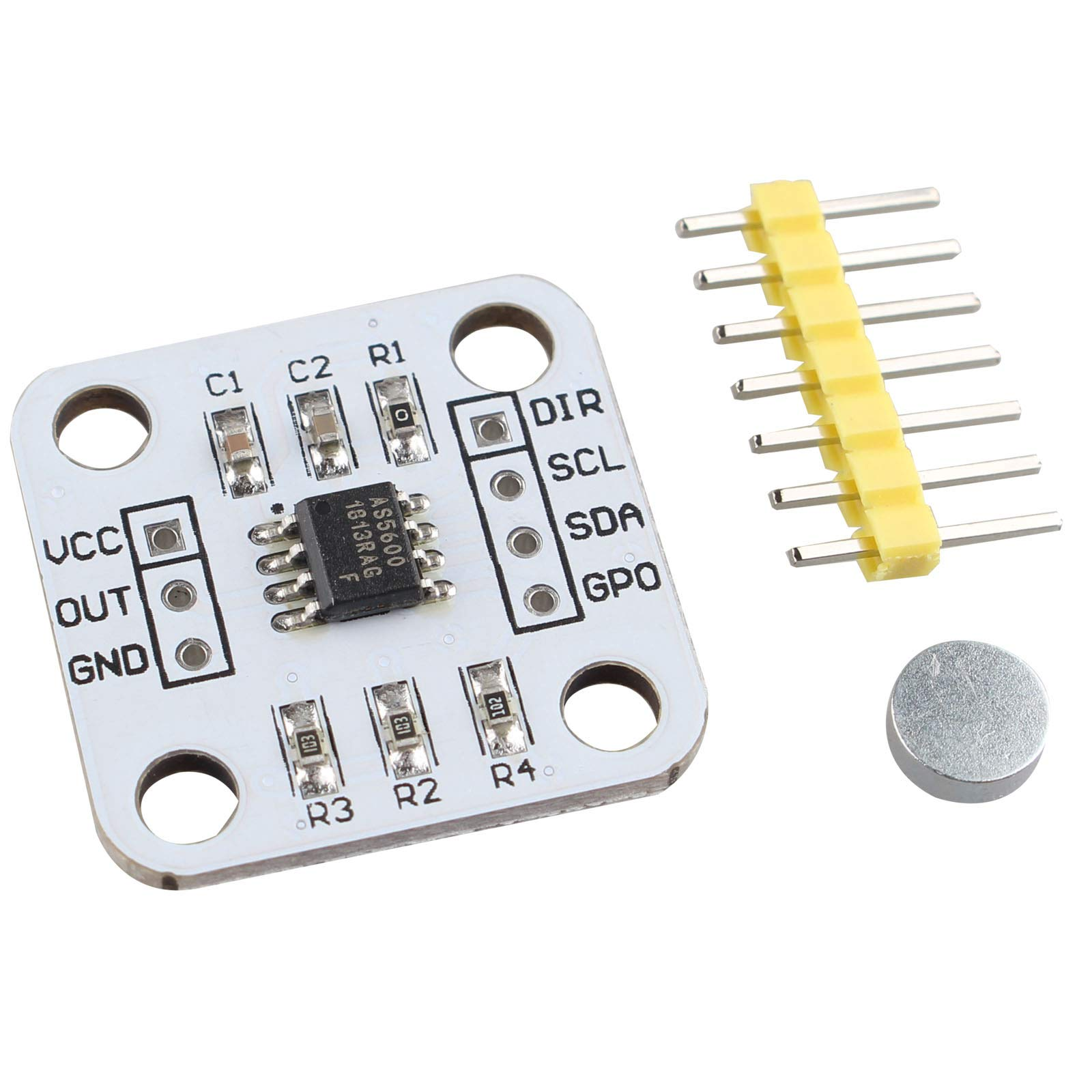
An AS5600 magnetic encoder read over I²C, mounted at the front of the kart near the steering shaft to keep the I²C run short. It was in use through the 2025 bench work and into 2026.
Retired 2026-07-12 after bench work in which it would not report a valid angle: with the chip touching a handheld magnet its magnitude reading peaked erratically and its magnet-detect flag stayed mostly at zero, and with that flag clear the chip gates its output regardless of output mode. That was not a wiring fault. Whether the same would have happened with the kart's mounted magnet is the open question in the callout above.
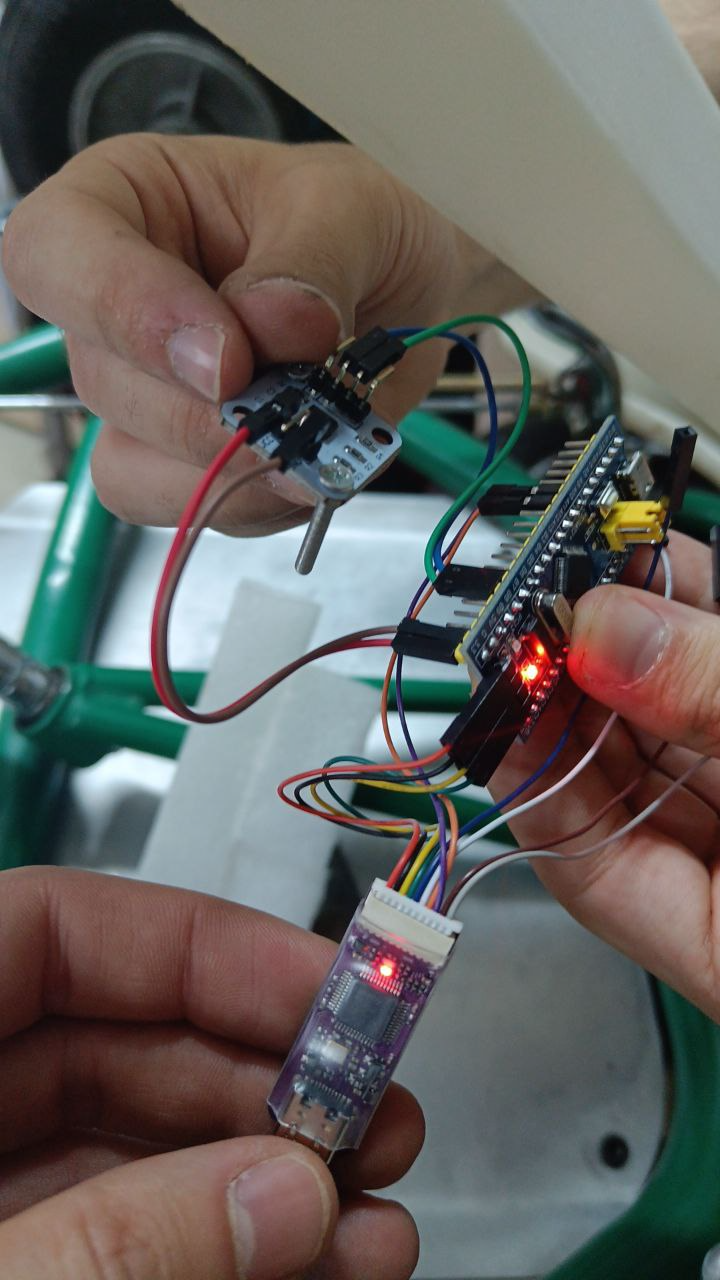
Hand-wired bench setup (June 2025): AS5600 breakout, an STM32 "Blue Pill", and a USB-serial adapter, before any of it moved onto the medulla PCB.
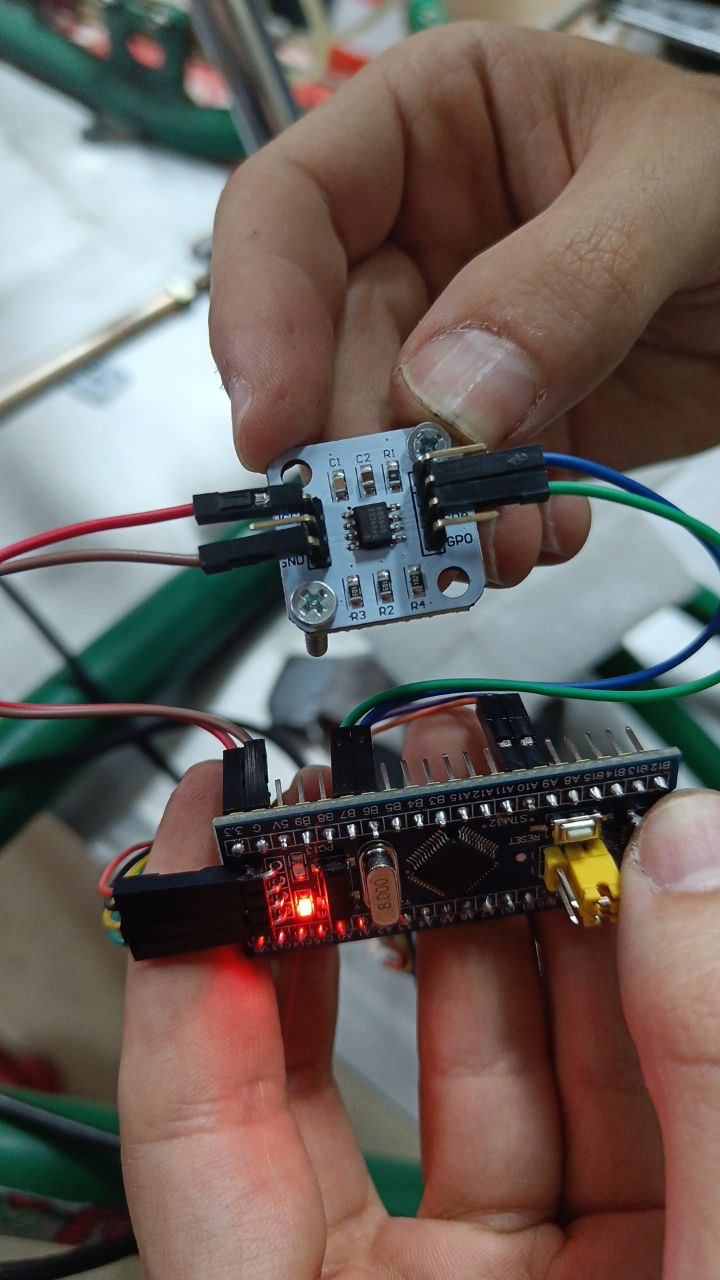
Basic Blue Pill reading code from that era, kept for reference: https://github.com/rubenayla/bluepill-angle-arduino.git
AS5600 wiring colours (obsolete — hand-wired harness only)
This colour code belonged to the hand-wired AS5600 setup and was never official. It does not describe anything currently on the kart.
| Colour | Signal |
|---|---|
| Grey / Black | GND |
| White | 3.3 V |
| Green | SDA |
| Blue | SCL |
The 2026-03 wiring note listed GND as black; the earlier 2025 harness used grey. Both existed, which is why this was never trustworthy without checking the actual wire.
Options considered and not used
- AS5600 in PWM mode. Attempted so that the front-mounted AS5600 could send a single wire to the rear, back when the plan still had the medulla moving there. It never produced a usable signal on the bench: the output pin read as floating, which traced to an open connection somewhere in the path from the chip's OUT pad through the terminal and its series resistors to the ESP32 — not to a proven dead chip. It also needs a one-time, irreversible OTP burn to enable, which made it a poor thing to gamble on.
- MPS MagAlpha MA732. The sensor-research pick, and in the same in-plane direction-sensing class as the MT6701, with better off-axis tolerance. Not bought: it is a bare QFN chip needing a breakout, pricier and slower to source, and the ~€10 MT6701 module solves the same magnet problem and was already in hand. Worth revisiting only if the MT6701's mounting ever fights the kart's sideways-magnet geometry.
Detailed comparison of the two sensing principles, with the datasheet citations behind them, is
in kart-medulla/history.md (2026-07-11 and 2026-07-12).