Previous Steering Designs
The current steering — a salvaged DC motor turning the column through a 3D-printed planetary — is not where this started. Two earlier directions were built and abandoned. This page records them and why they were dropped, so the reasoning isn't lost and nobody re-walks a dead end.
The Maxon EPOS linear actuator (2023–2024)
The first autonomous-steering design didn't turn the column at all — it pushed the steering linkage with a linear actuator, the way a lot of Formula Student driverless cars do.
The hardware was a sponsored Maxon stack:
| Part | Spec |
|---|---|
| Motor | Maxon EC-i 30 brushless — 12 V, 30 W, ~9200 rpm |
| Encoder | Maxon ENC 16 EASY |
| Gearhead | GP32 spindle drive with ball screw — 4.8:1, 200 mm spindle, 517 N continuous / 1369 N peak feed force, ~56 mm/s |
| Controller | EPOS4 positioning controller, driven over CANopen |
| Angle feedback | Vert-X 31E contactless hall sensor |
Why it was dropped:
- Cost. The Maxon stack was a sponsored quote, but it's a whole-kart's-budget part — not reproducible or repairable on our own money. A failure mid-season had no cheap path back.
- Commissioning pain. Bringing up the EPOS4 over CANopen fought us the whole way — position-sensor index errors (
0x7382), hall-angle detection errors (0x738a), sensor-resolution errors (0x7381). The control chain was a black box we didn't own. - It tied steering to one supplier's ecosystem (EPOS Studio, CANopen object dictionary, Maxon-specific firmware) instead of plain PWM we could debug ourselves.
So the team pivoted to something we could build, break, and reprint for a few euros: a motor on the column.
The first rotary reducer (3-planet nylon, ≈16:1)
The first column-drive reducer was also a printed planetary, but with the older geometry:
| Stage | Then | Now |
|---|---|---|
| Planetary | sun 10t / planet 17t / ring 44t, 3 planets, 5.4:1 | sun 12 / planet 16 / ring 44, 4 planets, 4.67:1 |
| Output pair | 3:1 | 13t / 31t, m3, 2.38:1 |
| Total | ≈ 16:1 | ≈ 11.1:1 |
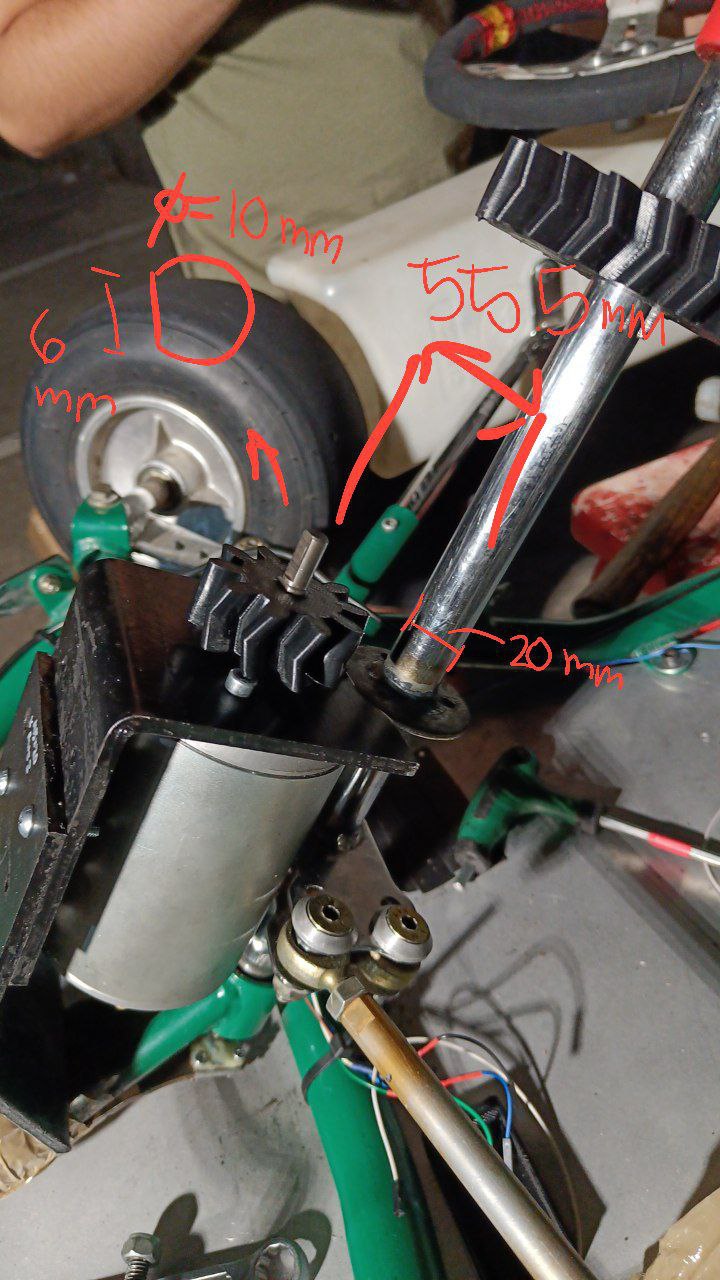
Early build, hand-measured on the kart: the salvaged DC motor's pinion driving the printed output gear on the column. The numbers scribbled here are a snapshot, not current spec — the output-pair spacing marked 55.5 mm is 66 mm in the current design. Live values are on the Steering System and Reducer pages.
What changed and why:
- 3 → 4 planets. With a 12-tooth sun and a 44-tooth ring, the assembly condition
(Z_sun + Z_ring)/Nonly divides evenly for 4 planets, not 3 — so the move to an off-the-shelf 12-tooth sun forced 4 planets. The upside: load is shared across four meshes instead of three. - Ratio rebalanced from ≈16:1 to ≈11.1:1 when the sun moved to the off-the-shelf Norelem hub geometry. The column still gets the ~8 Nm it needs (see sizing); the planetary dropped from 5.4:1 to 4.67:1 as a side effect of buying the sun rather than printing it.
The gear-material saga
The reducer went through several materials before the failure mode was actually understood — it's the motor-shaft D-flat, not the gear teeth. Full version on the reducer page; the short history:
| Material | What happened |
|---|---|
| PLA | brittle — teeth snapped, gears split within minutes of load. Broke after ~5 laps. |
| ABS | tougher than PLA, takes more heat — the current printed material for planets and carrier. |
| Nylon (PA) | low friction and tough, but creeps: the motor-shaft D-flat rounds off and slips. Absorbs moisture too. |
| Steel sun (Norelem) | the endgame for the one part that matters — the off-the-shelf steel hub sun fixes the D-flat regardless of what the rest is printed in. |
CAD lineage
The design has churned through many versions in Fusion 360 — the planetary alone went past v50, and the full kart_assembly past v110. The gears themselves are generated with the GF Gear Generator plugin (see reducer).